Mineral guide
How to Identify Malachite
Cu₂CO₃(OH)₂
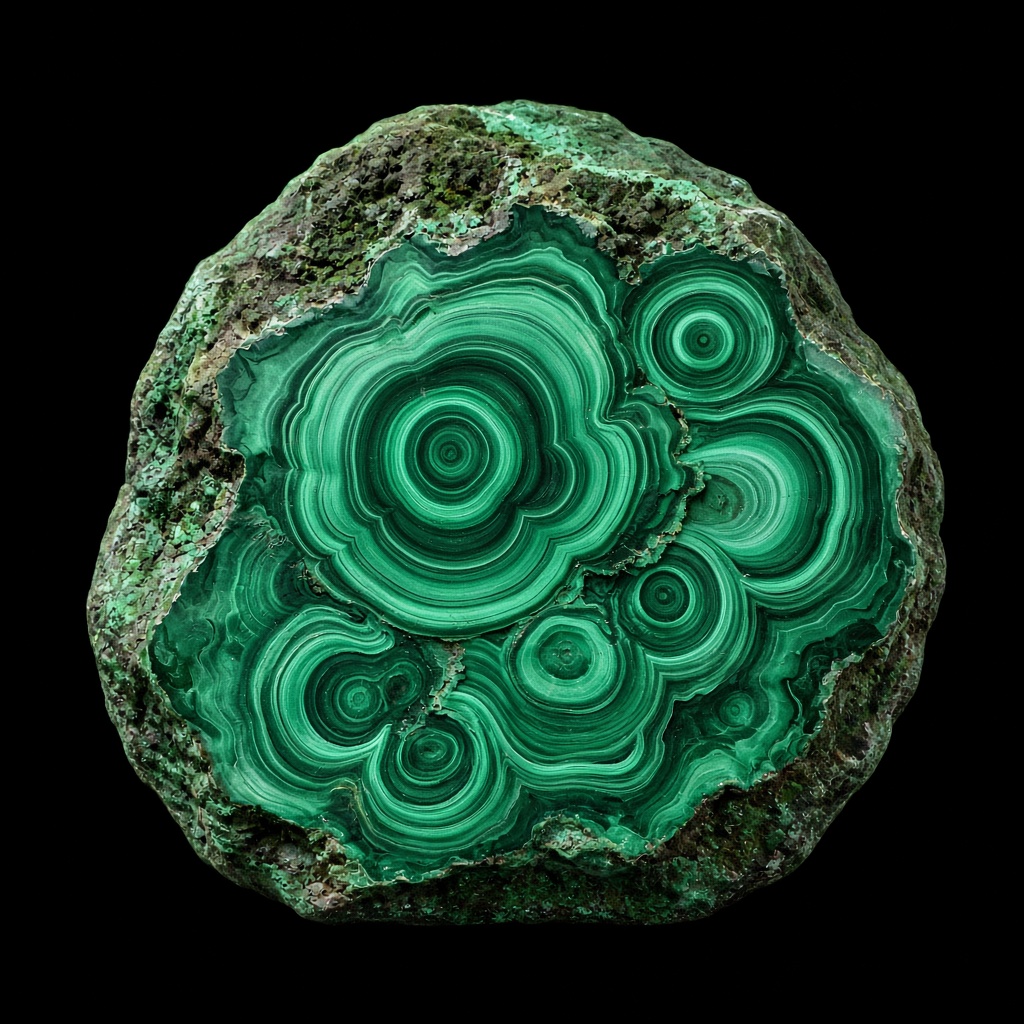
Malachite is a bright green copper carbonate with banded or botryoidal patterns. Identify it by rich green banding, Mohs ~3.5–4, and copper association — and screen dyed howlite/resin fakes that mimic the bands.
About Malachite
Malachite is a bright green copper carbonate with banded or botryoidal patterns. Identify it by rich green banding, Mohs ~3.5–4, and copper association — and screen dyed howlite/resin fakes that mimic the bands.
Malachite is filed under minerals in the RockScan directory. Composition: Copper carbonate hydroxide. It forms via oxidation zones of copper deposits. Typical occurrence: DRC, Zambia, Russia (Ural), Arizona. For the broader method, see how to identify rock types.
Malachite properties
| Mohs hardness | 3.5–4 |
|---|---|
| Class | mineral |
| Scientific name | Cu₂CO₃(OH)₂ |
| Color | Bright to dark green banding |
| Luster | Silky to adamantine (crystals); silky-banded in masses |
| Crystal system / texture | Monoclinic |
| Composition | Copper carbonate hydroxide |
| Formation | Oxidation zones of copper deposits |
| Occurrence | DRC, Zambia, Russia (Ural), Arizona |
How to identify Malachite
- Bright to deep green banding.
- Mohs ~3.5–4; green streak.
- Often botryoidal; associated with azurite.
Lookalikes to rule out
- Dyed howlite / resin: Fakes show uniform dye and plastic warmth; real malachite has irregular concentric banding and cool density.
- Chrysocolla: Chrysocolla is often bluer/cyan and less neatly banded; malachite is rich green with bull’s-eye bands.
- Serpentine: Serpentine is usually softer mottled green without classic malachite banding.
Photo tips for Malachite ID
- Macro concentric banding — the diagnostic pattern.
- Avoid oversaturating greens in editing.
- Show a polished face if available; rough shows different texture.
Snap one specimen in natural light, then open the result in the online studio or the rock identifier app.
Malachite FAQ
How do you identify malachite?
Green copper mineral with irregular concentric bands. Soft compared with quartz; fakes often look too uniform.
Malachite vs dyed stone?
Natural banding varies in thickness; dye jobs look printed or perfectly repetitive.
Is malachite toxic to handle?
Finished specimens are commonly handled; avoid inhaling dust when cutting — copper minerals need normal lapidary care.
How to identify malachite
Banded green stones are often sold as malachite. Use pattern quality and hardness:
- Banding / botryoidal: concentric green bands or bubbly botryoidal surfaces are classic.
- Hardness: Mohs ~3.5–4 — softer than jade or quartz; knife can mark.
- Color depth: rich emerald to dark green; neon uniform dye is suspicious.
- Fake screen: resin and dyed stones may show plastic sheen or identical repeating print bands.
- Photo first: macro of band curves in shade, then RockScan vs chrysocolla and fakes.
Malachite vs dyed howlite/resin vs chrysocolla vs serpentine
- Dyed howlite / resin: unnatural dye, plastic feel, or printed repeating bands.
- Chrysocolla: often bluer-green silica-copper mix; different hardness/habit.
- Serpentine: greasier green without sharp malachite banding; different toughness story.
Photo tips for malachite ID
Macro banding without glare; one scale shot. Compare turquoise, jade, and agate (for banding habit contrast), then confirm in the online studio or rock identifier app.
Related minerals to compare
Browse all: rocks · minerals · crystals · directory · what rock is this · rock vs mineral vs crystal. Confirm with the online studio or rock identifier app.