Crystal & mineral guide
Sugilite
KNa₂(Fe,Mn,Al)₂Li₃Si₁₂O₃₀
Royal purple cyclosilicate — scarce and popular with collectors.
Identify Sugilite with RockScanAbout Sugilite
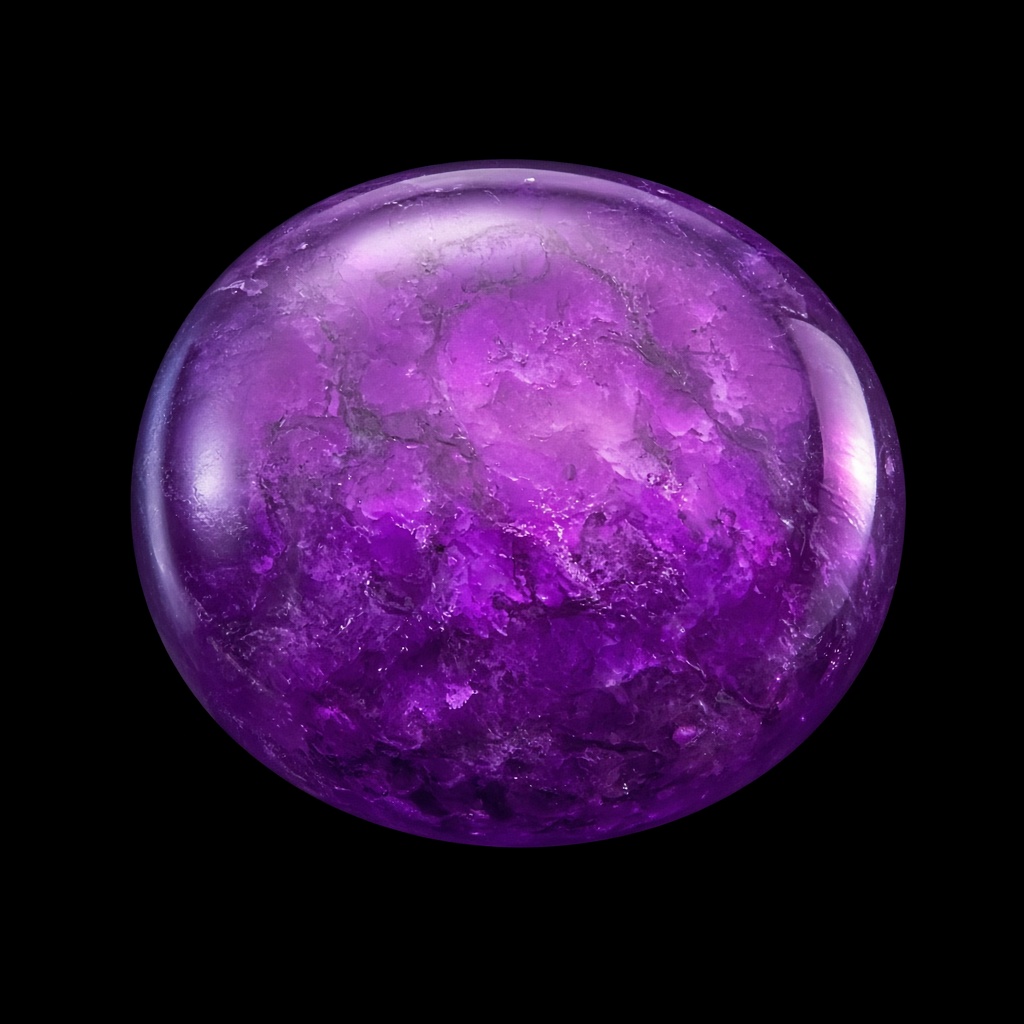
Sugilite's vivid purple made it a 1980s–90s specialty gem. Fine translucent material (gel sugilite) is rare. Mostly opaque cabochon grade from South African manganese mines. Distinguish from dyed stones by uneven natural texture.
Sugilite belongs in a crystal identifier workflow because photo cues — color zoning, crystal habit, and surface luster — combine with measurable traits like Mohs 5.5–6.5 and specific gravity 2.74–2.80. Use RockScan’s camera to get a first-pass ID, then confirm with the checklist below.
Sugilite properties
| Mohs hardness | 5.5–6.5 |
|---|---|
| Crystal system | Hexagonal |
| Luster | Vitreous to resinous |
| Color | Purple to magenta |
| Composition | Complex lithium cyclosilicate |
| Formation | Manganese-rich metamorphic environments |
| Occurrence | South Africa (Wessels/N'Chwaning), Japan (type), Canada |
| Specific gravity | 2.74–2.80 |
| Cleavage | Poor |
How to identify Sugilite
- Opaque to translucent purple
- Often with black matrix
- SG ~2.76; hardness mid-6
Collector notes
- Named for Japanese petrologist Ken-ichi Sugi
- Trade nickname 'luvulite' appeared in the 1980s
Value context: Translucent gel-grade purple is scarce and expensive.
Sugilite FAQ
How do you identify Sugilite?
Sugilite (KNa₂(Fe,Mn,Al)₂Li₃Si₁₂O₃₀) is typically recognized by purple to magenta color, vitreous to resinous luster, Mohs hardness 5.5–6.5, and hexagonal crystal system. RockScan can suggest Sugilite from a photo and surface these checks on the result card.
What is Sugilite made of?
Sugilite composition: Complex lithium cyclosilicate. It forms via manganese-rich metamorphic environments and is found in South Africa (Wessels/N'Chwaning), Japan (type), Canada.
Is Sugilite valuable?
Translucent gel-grade purple is scarce and expensive.