Crystal & mineral guide
Moonstone
Feldspar (orthoclase/albite)
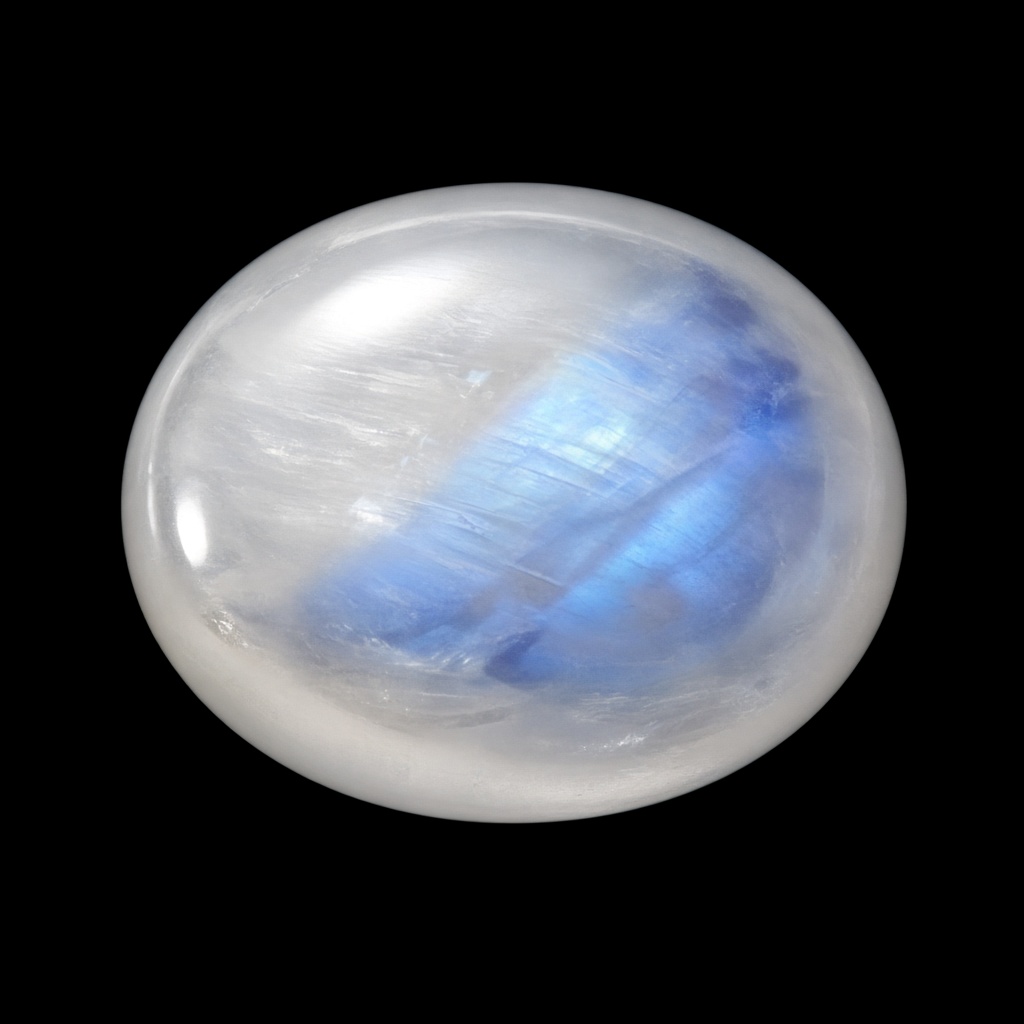
Feldspar gem showing floating blue billowy light — adularescence.
Identify Moonstone with RockScanAbout Moonstone
Moonstone's glow comes from light scattering between microscopic feldspar layers. Blue sheen on a colorless body is most valued. Care needed because of perfect cleavage and modest hardness.
Moonstone belongs in a crystal identifier workflow because photo cues — color zoning, crystal habit, and surface luster — combine with measurable traits like Mohs 6–6.5 and specific gravity 2.56–2.62. Use RockScan’s camera to get a first-pass ID, then confirm with the checklist below.
Moonstone properties
| Mohs hardness | 6–6.5 |
|---|---|
| Crystal system | Monoclinic |
| Luster | Vitreous |
| Color | Colorless to peach with blue adularescence |
| Composition | Potassium/sodium aluminum silicate intergrowth |
| Formation | Pegmatites and metamorphic rocks |
| Occurrence | Sri Lanka, India, Myanmar, Madagascar |
| Specific gravity | 2.56–2.62 |
| Cleavage | Perfect |
How to identify Moonstone
- Billowy blue sheen that moves with tilt
- Feldspar cleavage
- SG near 2.58
Collector notes
- Art Nouveau jewelers favored moonstone settings
- Rainbow moonstone is often labradorite marketed by effect
Value context: Strong blue adularescence in clean stones brings premiums.
Moonstone FAQ
How do you identify Moonstone?
Moonstone (Feldspar (orthoclase/albite)) is typically recognized by colorless to peach with blue adularescence color, vitreous luster, Mohs hardness 6–6.5, and monoclinic crystal system. RockScan can suggest Moonstone from a photo and surface these checks on the result card.
What is Moonstone made of?
Moonstone composition: Potassium/sodium aluminum silicate intergrowth. It forms via pegmatites and metamorphic rocks and is found in Sri Lanka, India, Myanmar, Madagascar.
Is Moonstone valuable?
Strong blue adularescence in clean stones brings premiums.