Crystal & mineral guide
Malachite
Cu₂CO₃(OH)₂
Banded green copper mineral — field indicator of copper oxidation zones.
Identify Malachite with RockScanAbout Malachite
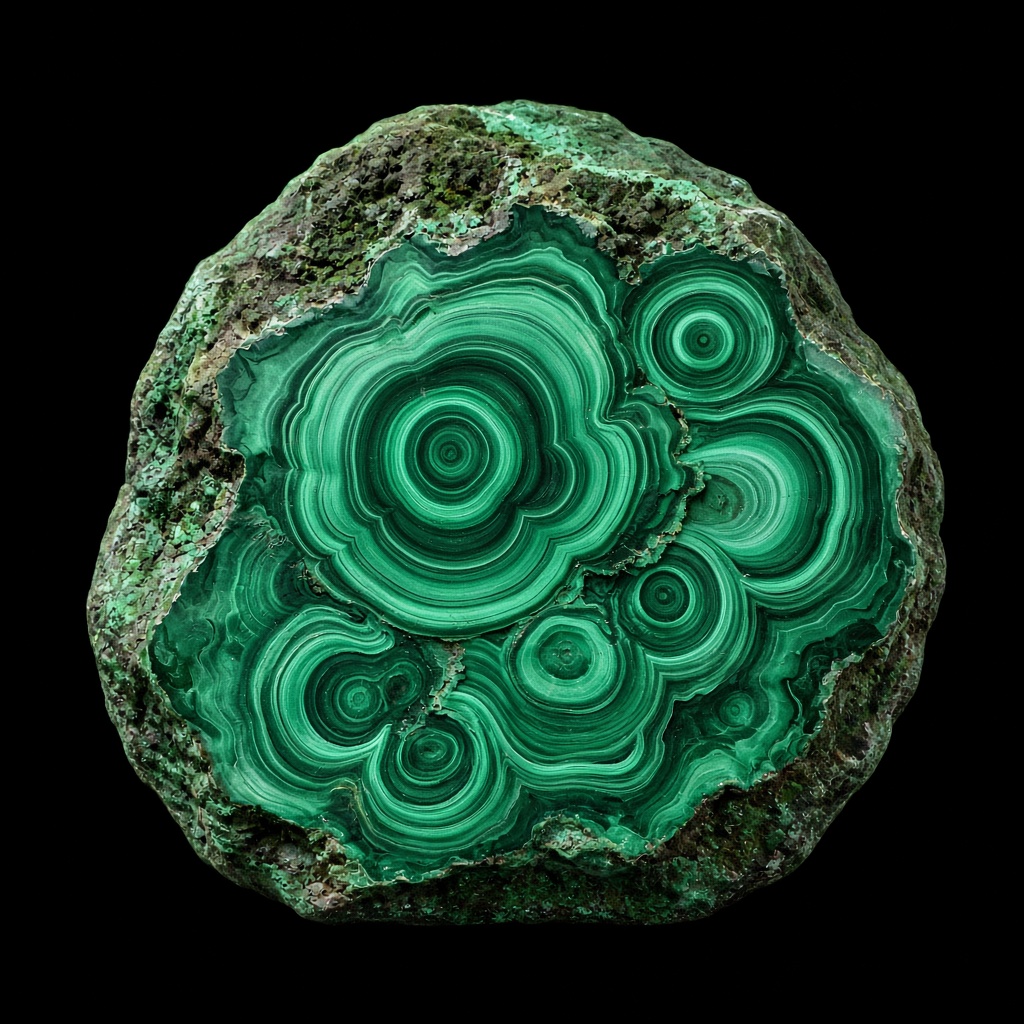
Malachite's concentric banding makes it a favorite for cabochons and décor. Softness means it scratches easily and reacts to acids. Dust from cutting should not be inhaled; wet cutting is standard. Often associates with azurite in the same ore bodies.
Malachite belongs in a crystal identifier workflow because photo cues — color zoning, crystal habit, and surface luster — combine with measurable traits like Mohs 3.5–4 and specific gravity 3.6–4.0. Use RockScan’s camera to get a first-pass ID, then confirm with the checklist below.
Malachite properties
| Mohs hardness | 3.5–4 |
|---|---|
| Crystal system | Monoclinic |
| Luster | Silky to adamantine (crystals); silky-banded in masses |
| Color | Bright to dark green banding |
| Composition | Copper carbonate hydroxide |
| Formation | Oxidation zones of copper deposits |
| Occurrence | DRC, Zambia, Russia (Ural), Arizona |
| Specific gravity | 3.6–4.0 |
| Cleavage | Perfect |
How to identify Malachite
- Green concentric bands
- High density for a carbonate
- Effervesces weakly with dilute acid
Collector notes
- Used as a green pigment in antiquity
- Often associated with azurite in the same deposits
Value context: Bold bull's-eye patterns in solid pieces are most desirable.
Malachite FAQ
How do you identify Malachite?
Malachite (Cu₂CO₃(OH)₂) is typically recognized by bright to dark green banding color, silky to adamantine (crystals); silky-banded in masses luster, Mohs hardness 3.5–4, and monoclinic crystal system. RockScan can suggest Malachite from a photo and surface these checks on the result card.
What is Malachite made of?
Malachite composition: Copper carbonate hydroxide. It forms via oxidation zones of copper deposits and is found in DRC, Zambia, Russia (Ural), Arizona.
Is Malachite valuable?
Bold bull's-eye patterns in solid pieces are most desirable.